
Living with persistent, unyielding discomfort is an incredibly isolating experience that takes a massive toll on both your physical body and your mental well-being. Waking up every single morning already feeling exhausted, knowing you have to navigate your daily responsibilities while managing a baseline level of agonizing stiffness, is a reality that millions of people face. It is completely valid to feel frustrated when you are constantly relying on over-the-counter pain medications that only offer temporary masking of your symptoms, or when you are handed generalized advice that fails to address the unique complexities of your body. When the standard approach of treating isolated symptoms falls short, it is time to look at the bigger picture.
Adopting a holistic philosophy toward your well-being does not mean abandoning medical science; rather, it means applying a comprehensive, systems-based approach to your health. A holistic perspective recognizes that the human body is an intricately connected web of mechanical structures, chemical processes, and neurological pathways. You cannot successfully treat an aching knee without looking at the alignment of the hips, and you cannot heal inflamed tissue if your internal cellular environment lacks the necessary building blocks for repair. True healing requires addressing the root causes of dysfunction from multiple angles simultaneously.
The purpose of this in-depth guide is to provide you with a multi-disciplinary roadmap for managing and overcoming long-term physical distress. By breaking down the process into structural alignment, movement re-education, inflammation reduction, and internal metabolic health, you can shift from a passive state of enduring discomfort to an active, empowered state of recovery.

Realign Your Posture to Relieve Central Nervous System Pressure
The foundation of human movement relies entirely on the structural integrity of your skeleton, with the spine acting as the central pillar. Your spine does more than just hold you upright; it houses the central nervous system, which acts as the superhighway for every sensory and motor signal traveling between your brain and your limbs. When your posture degrades due to prolonged sitting, poor sleeping habits, or repetitive stress, the vertebrae can shift out of their optimal alignment. This shifting creates a dangerous domino effect: the surrounding muscles spasm to protect the unstable area, and the displaced joints place direct, mechanical pressure on the delicate nerve roots exiting the spinal column.
To stop aggravating these compressed nerves, you must perform a daily ergonomic audit of your immediate environment. A significant portion of chronic musculoskeletal distress originates directly from how we position our bodies during our daily routines.
-
Audit Your Workspace: Ensure your computer monitor is at eye level so you are not perpetually jutting your neck forward. Your chair should support the natural curve of your lower spine, and your feet should rest flat on the floor with your knees at a ninety-degree angle.
-
Evaluate Your Sleep Environment: Avoid sleeping on your stomach, which severely twists the cervical spine. If you sleep on your side, place a firm pillow between your knees to keep your hips squared. If you sleep on your back, a small bolster under your knees will take the pressure off your lumbar region.
-
Practice Active Postural Awareness: Set a timer every hour to perform a “posture check.” Roll your shoulders back and down, engage your core slightly, and tuck your chin to align your ears over your shoulders.
When poor posture has locked your joints into dysfunctional patterns, simply sitting up straight is rarely enough to fix the problem. This is where seeking a targeted back pain treatment becomes essential. You need an intervention that addresses the mechanical locking of the joints. By undergoing a precise chiropractic adjustment, the restricted joints are safely manipulated to restore their proper range of motion. This process relieves the direct compression on the nerve roots, reduces localized muscle spasms, and allows the nervous system to communicate freely with the rest of the body without the interference of pain signals.
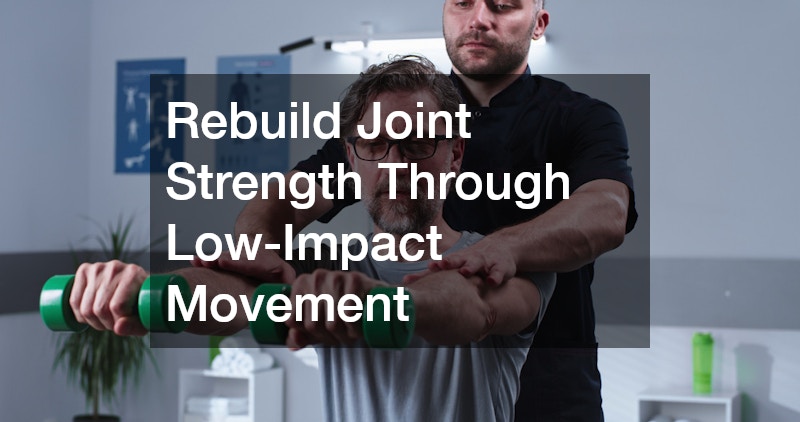
Rebuild Joint Strength Through Low-Impact Movement
There is a common misconception that when you are hurting, the best course of action is total bed rest. While acute, traumatic injuries certainly require a brief period of immobilization, resting for too long when dealing with chronic conditions actually accelerates the degradation of your body. Joints do not have their own blood supply; they rely on movement to pump nutrient-rich synovial fluid into the cartilage. When you stop moving, your joints literally starve and stiffen, and the muscles supporting those joints begin to atrophy. However, forcing a compromised body through high-impact exercises like running or heavy weightlifting will only cause further damage.
The goal is to rebuild your muscular strength and correct faulty movement patterns without placing excessive load on your vulnerable joints. This requires a strategic, guided approach to exercise.
-
Focus on Isometric Exercises: Isometrics involve contracting a muscle without actually moving the surrounding joints (like a plank or a wall sit). This allows you to build foundational strength and stabilize a painful area without grinding the cartilage.
-
Prioritize Core Stability: Your core is the anchor for your entire body. Strengthening your deep abdominal muscles and glutes takes an immense amount of pressure off your lower spine and knees during daily activities.
-
Embrace Gentle Mobility Flows: Incorporate daily movements like cat-cow stretches or gentle rotational exercises to continuously lubricate the joints and maintain your active range of motion.
To effectively re-educate your neuromuscular system, engaging in customized physical therapy is highly recommended. A professional can identify exactly which muscles are overcompensating and which are dangerously weak, creating a customized regimen to restore balance. One of the most effective ways to accomplish this is through an aquatic therapy session. When you are submerged in chest-deep water, buoyancy eliminates up to eighty percent of your body weight, entirely removing the gravitational compression on your spine, hips, and knees. The hydrostatic pressure of the water also naturally reduces swelling, allowing you to perform resistance exercises and rebuild strength in a safe, pain-free environment.

Correct Your Gait and Assess Your Foundational Support
Imagine trying to build a multi-story house on a foundation that is crumbling on one side; no matter how perfectly you construct the upper floors, the entire structure will eventually lean, crack, and fail. The human body operates on the exact same mechanical principle, known as the kinetic chain. Your feet are your foundation. Every time you take a step, the force of your body weight interacting with the ground sends shockwaves up through your ankles, into your knees, through your hips, and all the way up into your cervical spine. If your feet are not providing a stable, balanced platform, every joint above them is forced to compensate.
One of the most practical things you can do at home is to inspect the wear patterns on the bottom of your everyday shoes. This simple audit can reveal the hidden causes of your upper-body discomfort.
-
Identify Overpronation: If the inner edges of your shoe soles are heavily worn down, your arches are likely collapsing inward when you walk. This forces your knees to cave in (valgus) and pulls your pelvis out of alignment, severely straining the lower back.
-
Identify Supination: If the outer edges of your shoes show the most wear, your feet are rolling outward. This indicates poor shock absorption, meaning the raw impact of walking is being shot directly up into your leg bones and hip sockets.
-
Check for Asymmetry: If one shoe is significantly more worn than the other, you likely have a functional leg-length discrepancy or a severe pelvic tilt that needs immediate correction.
If you notice these uneven patterns, it is highly advisable to consult a specialized foot doctor who can properly evaluate the biomechanics of your stride. They can utilize digital pressure mapping and gait analysis to design custom orthotics that perfectly support your arches and correct your foot strike. However, fixing the foundation is only half the battle. Because your body has likely spent years adapting to your uneven stride, your muscles and joints are locked into asymmetrical patterns. Pairing your new orthotics with routine chiropractic treatments ensures that as your feet are corrected, your spine and pelvis are simultaneously realigned, creating a unified, balanced musculoskeletal system from the ground up.

Shock Your System to Drastically Reduce Systemic Inflammation
Inflammation is not inherently bad; it is your immune system’s natural, necessary response to injury or infection. When you sprain an ankle, acute inflammation rushes blood, white blood cells, and nutrients to the area to initiate healing. However, when the body is subjected to constant physical stress, poor biomechanics, or a highly processed diet, that localized response transforms into chronic, systemic inflammation. This means your immune system is perpetually active, flooding your tissues with inflammatory cytokines that degrade cartilage, irritate nerve endings, and cause a constant, dull, widespread ache. Traditional ice packs are fine for a bumped knee, but they cannot penetrate deeply enough to lower systemic inflammatory markers.
To combat this, you need to introduce controlled, acute stressors to your body that trigger a massive anti-inflammatory cascade. Deliberate cold exposure is one of the most powerful tools available for this purpose.
-
Start with Contrast Showers: If you are new to cold therapy, begin by ending your daily warm shower with thirty to sixty seconds of purely cold water. Focus on controlling your breathing and resisting the urge to tense your shoulders.
-
Understand Vasoconstriction: Cold exposure forces the blood vessels in your extremities to violently constrict, pushing blood back toward your vital organs. When you warm back up, the vessels dilate, flushing fresh, highly oxygenated blood back through your damaged tissues, pushing out stagnant cellular waste.
-
Harness the Endorphin Rush: The shock of the cold triggers a massive release of norepinephrine and endorphins in the brain, providing natural, potent relief that can last for several hours.
While a cold shower is a great start, utilizing professional-grade cold plunge therapy provides a much more profound physiological reset. Submerging your body in water that is maintained between forty and fifty degrees Fahrenheit for just three to five minutes forces a systemic vascular response that cannot be achieved at home. Because this can be an intense experience that temporarily spikes your heart rate and blood pressure, it is incredibly beneficial to utilize the advanced equipment at a modern physical rehab center. In a clinical setting, professionals can monitor your time and temperature, ensuring you reap the maximum anti-inflammatory benefits safely while integrating the cold exposure into your broader recovery protocol.

Address Internal Deficiencies to Accelerate Cellular Repair
It is entirely possible to have perfect posture, perform daily mobility exercises, and utilize the best anti-inflammatory modalities in the world, yet still suffer from chronic discomfort. Why? Because you cannot out-rehabilitate a toxic or deficient internal cellular environment. Your body is constantly breaking down and rebuilding tissue—cartilage, muscle fiber, and bone density are in a perpetual state of turnover. This rebuilding process requires an immense amount of energy and specific biological building blocks. If your internal chemistry is out of balance, your body simply lacks the materials required to heal the micro-tears that cause daily aches.
You must take an active role in understanding your internal metrics by requesting a comprehensive blood panel from your primary care physician to rule out the metabolic imbalances that stall tissue repair.
-
Check Vitamin D and Calcium: Vitamin D deficiency is rampant and directly correlates with deep, aching bone pain and severe muscle weakness. It is vital for calcium absorption, which keeps your skeletal structure dense and resilient.
-
Analyze Inflammatory Markers: Ask your doctor to test your C-Reactive Protein (CRP) and Erythrocyte Sedimentation Rate (ESR). High levels of these markers indicate that your immune system is actively attacking your own tissues, which is common in autoimmune conditions that cause joint pain.
-
Evaluate Thyroid Function: An underactive thyroid (hypothyroidism) drastically slows down your cellular metabolism, leading to fluid retention in the joints, severe muscle stiffness, and an agonizing lack of energy.
Furthermore, the endocrine system plays a massive role in maintaining the integrity of your musculoskeletal system. As we age, our natural production of essential hormones declines. A severe drop in testosterone (in both men and women) leads to rapid muscle atrophy, leaving the joints unsupported and vulnerable to grinding. Similarly, a drop in estrogen drastically reduces bone density and the elasticity of connective tissues like tendons and ligaments. In cases where blood work reveals severe clinical deficiencies, medically supervised hormone replacement can be a profoundly effective intervention. By restoring your internal chemistry to optimal levels, you provide your body with the biological tools it needs to repair damaged tissues. Ultimately, true, lasting physical rehabilitation is not just about stretching and strengthening the outside of your body; it is a holistic commitment to optimizing the internal environment so that healing can occur at the deepest cellular level.
Conclusion
Overcoming a chronic physical condition is rarely achieved through a single, isolated intervention. The human body is a brilliantly complex machine, and when it falls into a state of persistent distress, it requires a multifaceted approach to restore harmony. By meticulously aligning your skeletal structure, re-educating your muscles through low-impact movement, aggressively combating systemic inflammation, and optimizing your internal cellular chemistry, you tackle the root causes of your discomfort rather than merely silencing the alarms your body is sounding.
It is vital to approach this journey with a profound sense of patience and self-compassion. The dysfunctional movement patterns and inflammatory cycles that are currently causing you distress likely took years, or even decades, to develop. Unwinding that damage and rebuilding a resilient, functional body will naturally take time, consistency, and a willingness to adapt your lifestyle. Celebrate the small victories—a morning with slightly less stiffness, an extra block walked without a flare-up, or a night of uninterrupted sleep.
You do not have to accept chronic discomfort as a permanent fixture in your life. By assembling a diverse team of health professionals and taking an active, educated role in your daily habits, you can reclaim your mobility and your quality of life.