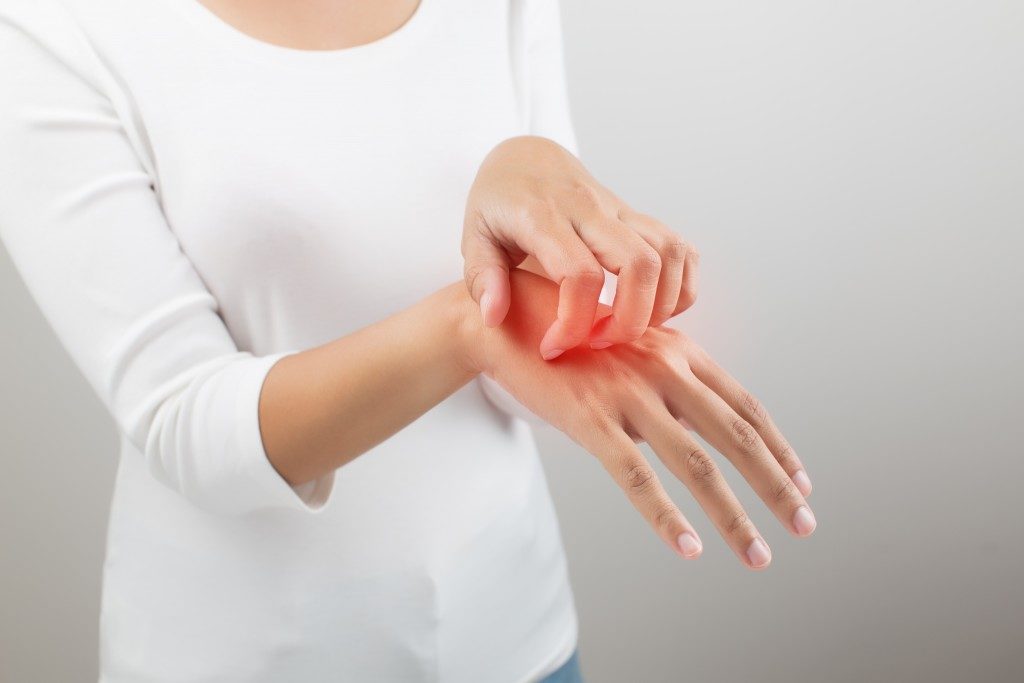
The surface you walk, run, or stand on every day is doing something to your joints — and most people never think about it until the damage compounds into something harder to ignore. Impact force, ground reaction energy, and surface compliance all influence how stress travels through the ankles, knees, hips, and lower back. For people already managing arthritis, tendinopathy, or post-surgical joints, the wrong surface doesn’t just feel uncomfortable — it actively works against recovery.
Understanding the mechanics behind surface choice can meaningfully change how you manage chronic joint pain over the long term.
How Surface Hardness Translates Into Joint Load
Every step generates a ground reaction force — a push back from the surface equal in magnitude to the force you put into it. On a hard, non-compliant surface like concrete or ceramic tile, that energy has nowhere to go except through your body. The musculoskeletal system absorbs the shock in sequence: foot, ankle, knee, hip, spine. When those joints are already inflamed or degraded, that repeated loading accelerates wear and provokes pain flares.
Research in biomechanics consistently shows that surface stiffness correlates with peak impact loading at the knee. A 2019 study published in the Journal of Sports Sciences found that runners on concrete experienced measurably higher tibial shock than those on asphalt or grass, even when footwear was controlled. Concrete is roughly ten times stiffer than asphalt, which itself is far less forgiving than natural turf.
What this means practically: if you spend six or more hours daily on hard flooring — common in retail, healthcare, or warehouse work — your joints are absorbing thousands of high-force impacts per shift. Anti-fatigue matting reduces peak ground reaction force by 25 to 50 percent depending on material density. Gel-core mats rated for industrial standing use outperform foam-only options for joints specifically because they maintain compliance over time rather than compressing flat within weeks.
For people managing chronic knee or hip pain, the most actionable change is often the cheapest: adding 3/4-inch-thick rubber or gel matting to the kitchen and bathroom floors where they stand most often, before investing in footwear changes or physical therapy add-ons.
Outdoor Surfaces and the Trade-Off Between Stability and Shock Absorption
Natural grass is widely considered the most joint-friendly outdoor surface because of its combination of cushioning and slight instability, which encourages neuromuscular engagement rather than passive impact. But grass has real liabilities — irregular terrain increases ankle inversion risk, wet conditions remove friction, and dry summer grass becomes surprisingly firm.
Asphalt sits in a practical middle zone. It absorbs more shock than concrete, wears predictably, and offers consistent footing. For people with moderate joint pain who walk or run regularly, asphalt paths are a reasonable default when grass isn’t accessible or reliable.
Engineered track surfaces occupy a specific performance category. Rubberized tracks — including polyurethane track surfacing used at many athletic facilities — are engineered to return energy while reducing peak impact loading compared to asphalt. This makes them well-suited for people with knee or hip osteoarthritis who want to maintain cardiovascular fitness without the cumulative load of harder surfaces.
The underappreciated trade-off here involves lateral stability. Highly cushioned surfaces reduce vertical impact but can slightly increase mediolateral joint movement, which matters for people with knee varus or valgus alignment issues. If joint instability is part of the clinical picture, a surface that is softer but less stable may not always be the right choice — a physiotherapist’s input on gait mechanics should guide the decision.
- Walk or jog on rubberized or tartan athletic tracks rather than concrete sidewalks if you have documented cartilage loss in the knee or hip.
- Avoid running on cambered roads — the lateral tilt increases asymmetric hip and knee loading over distances longer than two miles.
- Check grass surfaces for firmness before use: if the ground doesn’t give slightly underfoot, it offers less shock absorption than well-maintained asphalt.
Indoor Flooring Choices and Long-Term Joint Health
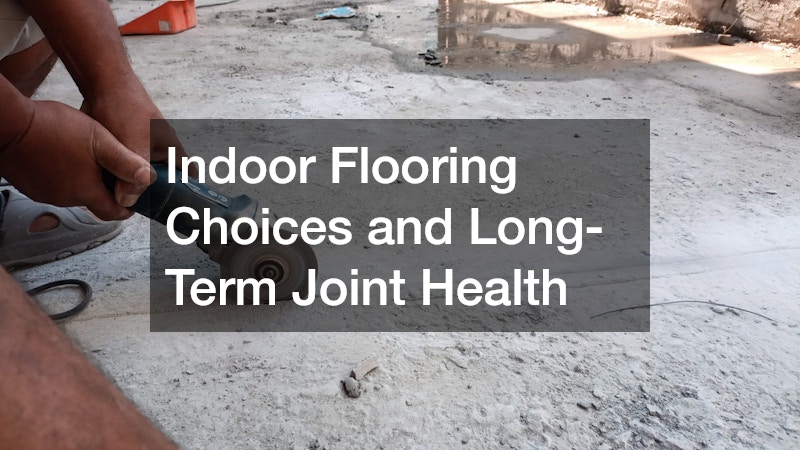
Indoor flooring is one of the most controllable variables in a joint pain management plan, and it is consistently underestimated. Hardwood and laminate rank among the worst options for high-traffic daily living with joint conditions — they are rigid, offer no energy return, and become unpredictable when wet. Tile and stone are worse still.
Cork and rubber flooring are clinically underutilized in home settings. Cork compresses approximately 40 percent under load and recovers quickly, distributing pressure across a larger surface area and reducing localized joint stress. Rubber flooring, common in gym environments, provides similar benefits with more durability and easier maintenance. Both materials cost more than laminate upfront — cork runs approximately $3 to $5 per square foot installed, rubber $4 to $8 — but for someone with daily joint pain, the functional return justifies the investment more straightforwardly than most wellness purchases.
Area rugs over hard floors are a lower-cost interim strategy, but the compliance benefit varies considerably by construction. Rugs with memory foam backing provide meaningful cushioning; flatweave rugs over bare hardwood offer almost none. Thickness and underlayment density matter more than fiber type.
Stair surfaces deserve separate attention. Hard-edged stair nosings on tile or wood stairs produce high-impact loading on the lead knee at each descent. Carpeted stairs or rubber stair tread inserts reduce this substantially — a relevant consideration for anyone with patellofemoral pain or knee replacement history.
- Replace smooth hardwood in high-use kitchen and hallway areas with cork or rubber tile if daily joint pain scores average above 4 out of 10.
- Use rugs with a minimum 1/2-inch memory foam underlay in rooms where you stand or walk for more than 30 minutes continuously.
- Install rubber stair tread inserts on hard-surface stairs if knee pain worsens consistently after stair descent.
Footwear as a Surface Modifier — and Its Limits
Footwear functions as a portable surface — it changes the effective compliance and geometry of whatever you stand on. High-quality midsole cushioning can partially offset the hardness of concrete or tile, which is why footwear advice is so often the first recommendation for joint pain sufferers. But it has real limits that matter clinically.
Maximalist cushioned shoes reduce impact peaks but can reduce proprioceptive feedback, which some research links to increased ankle and knee instability over time. Stability and motion-control shoes manage alignment but often sacrifice compliance. No single footwear category works universally; the right shoe depends on the specific joint affected, the gait pattern, and the primary surface being walked on.
A more reliable framework is to match footwear design to surface type rather than defaulting to maximum cushioning everywhere. On very hard surfaces — concrete, tile — thicker EVA or gel midsoles are justified. On already-compliant surfaces like rubber flooring or grass, a moderate-cushion shoe with better ground feel often performs better for joint stability and proprioception.
Custom orthotics offer a targeted alternative to broad footwear changes. A custom insole addresses individual biomechanical deviations — overpronation, supination, leg-length discrepancy — that generic cushioned shoes cannot correct. The cost differential is significant: custom orthotics run $300 to $600 compared to $100 to $180 for premium over-the-counter insoles. For isolated alignment-related joint pain, the custom option frequently produces better long-term outcomes; for general impact reduction, a well-fitted over-the-counter insole is often sufficient.
- Replace footwear used for daily walking every 400 to 500 miles, or when heel compression depth exceeds 30 percent of original midsole height.
- Request a gait analysis from a podiatrist or physical therapist before investing in custom orthotics — it identifies whether alignment correction or impact reduction is the actual priority.
- Avoid wearing footwear with worn-down lateral heel edges on hard floors — asymmetric heel contact amplifies medial knee load by a measurable degree.
Making Surface Changes Work in a Real Joint Pain Plan
Surface optimization is most effective when it’s treated as one layer of a broader management strategy rather than a standalone fix. The evidence supports surface modification as a genuine variable in joint load management — not a marginal one. But the gains compound when surface changes are combined with strengthening work that improves the musculature’s ability to absorb and distribute force before it reaches the joint itself.
Start with the surfaces you spend the most cumulative time on. For most people, that’s the home kitchen floor and their primary walking route. Modifying those two environments first produces a more consistent reduction in daily joint load than occasional choices made at the gym or on a track. Reassess pain scores after 6 to 8 weeks of consistent surface changes before adding further interventions — this isolates what the change is actually doing.